Bulkhead and cellar doors
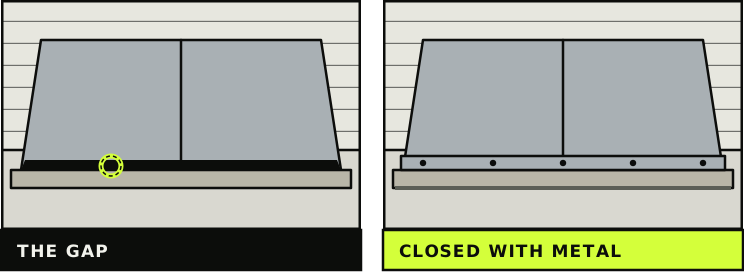
The angled metal door over the basement stairs rarely closes tight, at its edges or where the frame meets the foundation. The stairs behind it lead straight to the basement.
At your house
Not checked yet
Look at this spot with the free check. Your answers stay on this device.
Where to look
- The edges of the metal doors, where the two doors meet and where they close on the frame.
- Where the metal frame sits on the foundation, and where it meets the house wall.
- The door at the bottom of the stairs, into the basement.
Sign to look for Daylight at the door edges, droppings on the stairs, or a gap where the frame meets the foundation.
The rule of thumb: if a gap is about the width of your finger, a mouse can use it.
Why mice use it, and the common mistake
Why mice use it
The doors are metal on metal, so they rarely close tight, and the frame can pull away from the foundation over time. The stairs behind them lead straight to the basement.
Common DIY mistake
Counting on the outside doors alone. Metal doors rarely close tight, so the door at the bottom of the stairs has to keep mice out too.
The lasting fix
Mouse-proof the interior door at the bottom of the stairs, and add metal to close the gaps on the outside doors.
Materials
- Exterior-grade metal flashing or metal patch
- Exterior-grade screws or fasteners
- Polyurethane, RTV or acetoxy construction sealant
- Custom metal door sweep with an EPDM rubber seal, for the door at the bottom of the stairs
Safety notes
- Keep the bulkhead working as a way out of the basement. Nothing you add should stop the doors opening in an emergency.
The lasting fix, step by step
Check the outside doors
Look along every edge, and where the frame meets the foundation and the wall. Mark any gap about the width of your finger or wider.
Add metal to the outside doors
Close the gaps along the edges with exterior-grade metal fastened to the doors or frame, so the doors still open and close.
Seal the frame
Where the frame meets the foundation, fit metal into the gap and seal it in with polyurethane, RTV or acetoxy construction sealant.
Mouse-proof the inside door
Fit the door at the bottom of the stairs with a custom metal door sweep with an EPDM rubber seal, and close any gaps at its frame.
Materials
- Exterior-grade metal flashing or metal patch
- Exterior-grade screws or fasteners
- Polyurethane, RTV or acetoxy construction sealant
- Custom metal door sweep with an EPDM rubber seal, for the door at the bottom of the stairs
Safety notes
- Keep the bulkhead working as a way out of the basement. Nothing you add should stop the doors opening in an emergency.
Before you seal the last gap
- Make sure nothing is still living inside. If mice are already in, set indoor snap traps along the walls as you seal, never as a substitute for sealing.
- Clear clutter and cardboard away from walls and corners, so there are fewer places to nest.
Related spots
Mice that use this gap often use these too. Check them on the same walk.
When in doubt, seal ’em out.