Roof returns
A roof return is the small boxed end of an eave, where a lower roof runs into a wall or a dormer's eave ends on the main roof. It's often hollow inside, and it can open straight into the eaves.
At your house
Not checked yet
Look at this spot with the free check. Your answers stay on this device.
Where to look
- On a dormer, the end of the soffit board under the overhang on each side. It's usually cut short where the overhang meets the main roof, leaving an open end right beside the side wall. Look up from below with a flashlight to see it.
- Corners where a garage, porch or lower roof meets the wall of the house.
- Behind the metal flashing, where the roof joints meet. Water doesn't run up, so these joints are often left open.
- The underside and back of the boxed return, where the trim stops short of the wall.
- Droppings, chewed edges or nesting debris at the corner.
- Cobwebs with a little path through them. Something has been going in and out.
Sign to look for Droppings or chewed edges where a lower roof meets the wall, or scratching above the ceiling.
The rule of thumb: if a gap is about the width of your finger, a mouse can use it. Also called the pencil or pinky test. A young mouse needs only a 1/4-inch gap, about the thickness of a standard pencil, to get its skull through. If the skull fits, the body follows.
Why mice use it, and the common mistake
Why mice use it
Roof returns are flashed with metal so water running down stays out. Water doesn't run up, so builders often leave the joints behind the flashing open. To a mouse on the lower roof, that's a sheltered doorway straight into the roof space.
Common DIY mistake
Filling the joint with foam, cement or caulk. If water ever gets around the flashing or drip edge, a solid plug can dam it against the wall. Mice also chew through foam and caulk.
Packing this gap with cement or mortar. It won't stick to the metal soffit, so it works loose and rats squeeze right past, and it dams water against the roof deck, rotting the return below.
The lasting fix
Weatherproof 1/4-inch hardware cloth, stainless or heavy galvanized, pressure-fit into the joint and held with exterior-grade sealants or adhesives. It closes the gap and still lets water drain.
What NOT to seal
Some openings have to drain or breathe. Sealing them causes rot, mold or a safety problem.
- Never plug masonry weep holes solid. Cover them with breathable weep-hole guards, mesh or hardware cloth so water can still drain out.
- Never block combustion air vents. Gas furnaces and water heaters need that air to burn safely.
- Never block soffit or attic intake vents. The attic needs that airflow. Screen a damaged vent with hardware cloth instead of closing it.
- Never block dryer exhausts. They have to stay open to the outside.
The lasting fix, step by step
Find every return
Look at every place a lower roof meets a wall. Most houses have more than one, and each one needs checking.
Look closely first
From the ground, shine a strong flashlight up into the shadow under the end of the dormer's eave. If you can see a dark gap where it meets the roof, that's an opening. Check for bats before you seal. Look for droppings, dark rub stains, a clean hole through the cobwebs, or bats tucked in the gap. If you see any, don't seal it yourself, because bats need a proper exclusion so none get trapped inside. Look behind the flashing and trim too. It's less of a worry on a single-story house, but still look.
Never seal anything in
If something could be living behind the gap, don't seal it yet. If it could be bats, get a proper exclusion done rather than doing it yourself. For mice or other small animals, put a one-way exclusion device or netting over it so they can leave but can't get back in, and seal once they're out. On a two-story house, when in doubt, assume bats.
Pressure-fit hardware cloth
Builders often leave this gap open so water behind the flashing can drain. Don't caulk it shut. Cover it with metal hardware cloth secured to the building materials, which keeps animals out and still lets water escape. Cut weatherproof 1/4-inch hardware cloth (stainless or heavy galvanized) to fit the joints behind the flashing, including the back where the return meets the wall, and press it in snug.
Hold it, keep it draining
Hold it in place with exterior-grade sealants or adhesives. Don't pack the joint solid, so water can still drain past the flashing and drip edge.
In a townhouse row, roof returns are often where your roof meets your neighbor's wall. Your HOA usually needs to OK outside work.
Materials
- Weatherproof 1/4-inch hardware cloth, 19- or 23-gauge, stainless or heavy galvanized
- One-way exclusion device or netting, if mice or other small animals could be living behind the gap
- Exterior-grade sealants or adhesives (not standard acrylic caulk)
- Tin snips, gloves and eye protection
Specs that matter. Use 1/4-inch hardware cloth as the backing, then seal over it with exterior-grade sealants or adhesives. Half-inch mesh and cheap acrylic caulk from the hardware aisle won't stop young mice: they get their skulls through, and the body follows.
Safety notes
- Roof returns are usually reached from a ladder or a lower roof. Never work on a roof alone, and stay off wet or steep surfaces.
- Don't block flashing or gutters in a way that traps water against the wall.
- Wear gloves and a mask around droppings and nesting material.
- Bats are protected in many places. Check your local rules on timing before you exclude them.
Before you seal the last gap
- Make sure nothing is still living inside. If mice are already in, set enclosed snap traps along the walls as you seal, never as a substitute for sealing.
- Clear clutter and cardboard away from walls and corners, so there are fewer places to nest.
On a real house
Before photos from homes we’ve inspected, with the gap marked in highlighter.
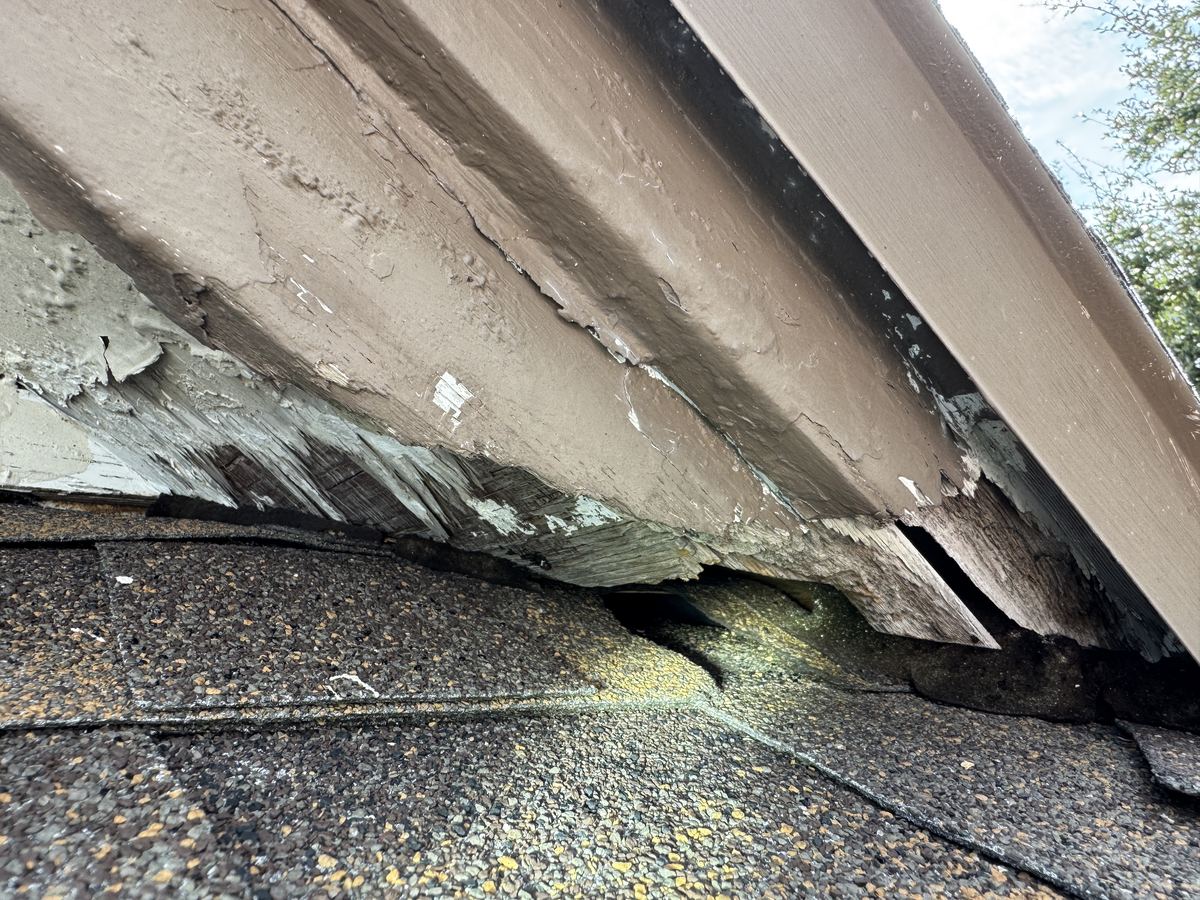 Before
Roof return: a gnawed opening where the trim meets the shingles. Out of sight from the ground, and wide open. - Before · clip
Clip: the gnawed roof return opening from a few angles.
Related spots
Mice that use this gap often use these too. Check them on the same walk.
When in doubt, seal em out.