Garage door corners and bottom seal
The bottom corners of a garage door are where a gap goes right in. That's where the seal wears, bends or stops short. If you can see daylight there, a mouse can get in.
At your house
Not checked yet
Look at this spot with the free check. Your answers stay on this device.
Where to look
- Start with the two bottom corners, where the door seal meets the side jambs. That's where a gap goes right in.
- A half circle chewed into the weather stripping at a bottom corner. That means mice are using this spot.
- Along the bottom seal, especially worn, torn or flattened sections.
- The side weatherstripping on the door frame.
- The door between the garage and the house, which needs its own sweep.
Sign to look for A half circle chewed into the weather stripping at a bottom corner, or droppings at the corners.
The rule of thumb: if a gap is about the width of your finger, a mouse can use it. Also called the pencil or pinky test. A young mouse needs only a 1/4-inch gap, about the thickness of a standard pencil, to get its skull through. If the skull fits, the body follows.
Why mice use it, and the common mistake
Why mice use it
Garage doors move every day, so seals wear out fastest at the corners. A garage is also full of shelter, and it connects to the house.
Common DIY mistake
Just swapping in a new rubber seal, or stuffing the corner with foam. Mice chew soft rubber, and they go for the bottom corners first. A half circle chewed into the weather stripping at a corner means one already did.
The lasting fix
Close the gap at each bottom corner with exterior-grade metal or cement, so there's nothing soft to chew. Seal metal in with exterior-grade sealants or adhesives.
The lasting fix, step by step
Check for daylight
Close the door, turn off the garage lights during the day, and look for light at the two bottom corners first, then along the bottom seal.
Replace a worn bottom seal
Fit a rodent-resistant bottom seal designed for your door's track.
Close the bottom corners
Install a garage door corner seal on each side, and close any gap left at the ground with exterior-grade metal or cement, so the corners close tight where the seal meets the jamb.
Seal the side gaps
Close gaps between the door frame and the wall with exterior-grade metal, sealed in with exterior-grade sealants or adhesives.
Do the house door too
Fit a custom metal door sweep on the door from the garage into the house.
For a shared or attached garage, the garage door may belong to the association. The door from the garage into your unit is usually yours to fix.
Materials
- Rodent-resistant garage door bottom seal
- Garage door corner seals
- Exterior-grade metal and fasteners
- Exterior-grade sealants or adhesives (not standard acrylic caulk)
- Custom metal door sweep (aluminum flashing or stainless steel hardware cloth, bent to fit)
Specs that matter. Use 1/4-inch hardware cloth as the backing, then seal over it with exterior-grade sealants or adhesives. Half-inch mesh and cheap acrylic caulk from the hardware aisle won't stop young mice: they get their skulls through, and the body follows.
Safety notes
- Never adjust garage door springs or cables yourself. They're under high tension. Call a garage door technician.
- Unplug the opener while you work on the door.
- After a new seal goes on, test the door's auto-reverse so it still stops for an obstruction.
Before you seal the last gap
- Make sure nothing is still living inside. If mice are already in, set enclosed snap traps along the walls as you seal, never as a substitute for sealing.
- Clear clutter and cardboard away from walls and corners, so there are fewer places to nest.
On a real house
Before photos from homes we’ve inspected, with the gap marked in highlighter.
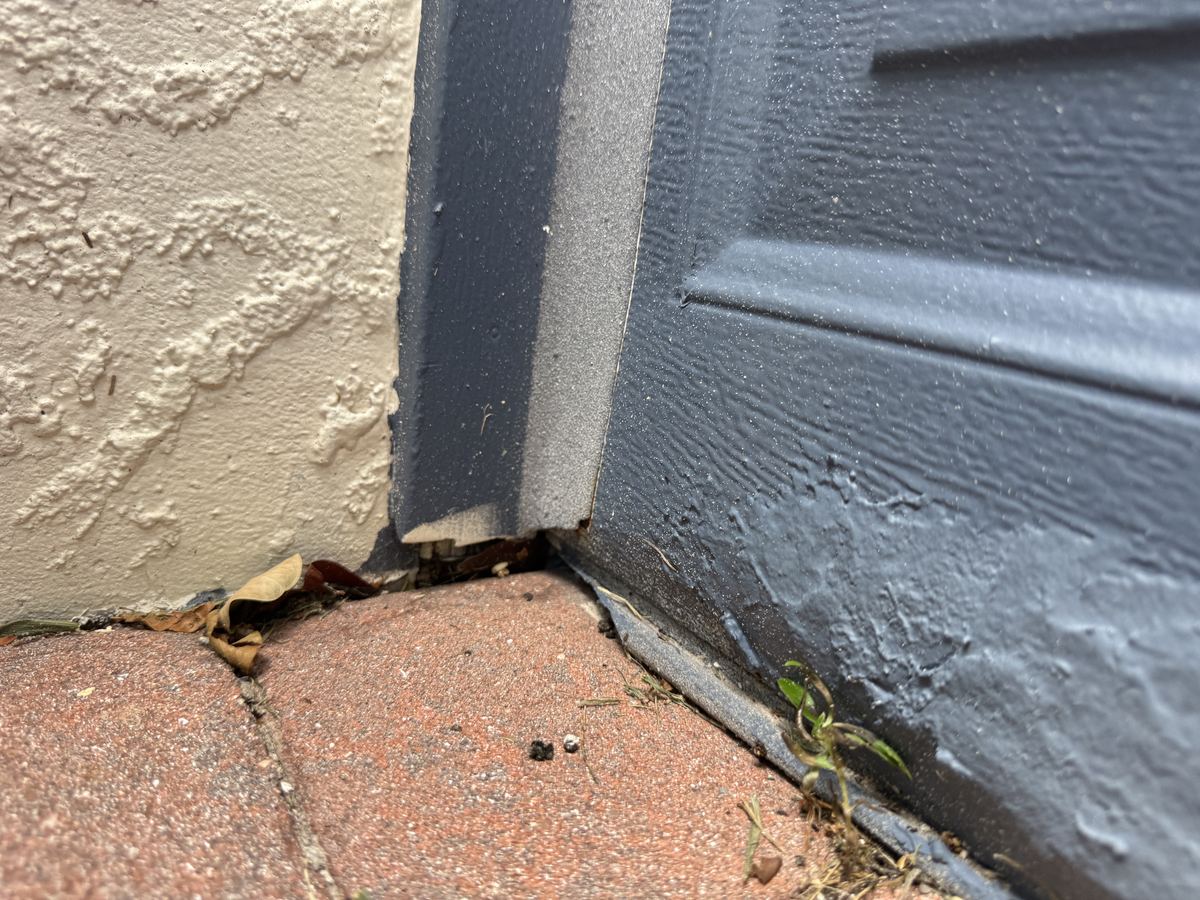 Before
Garage door corner: the bottom seal stops short of the jamb. If you can see daylight there, a mouse can get in. 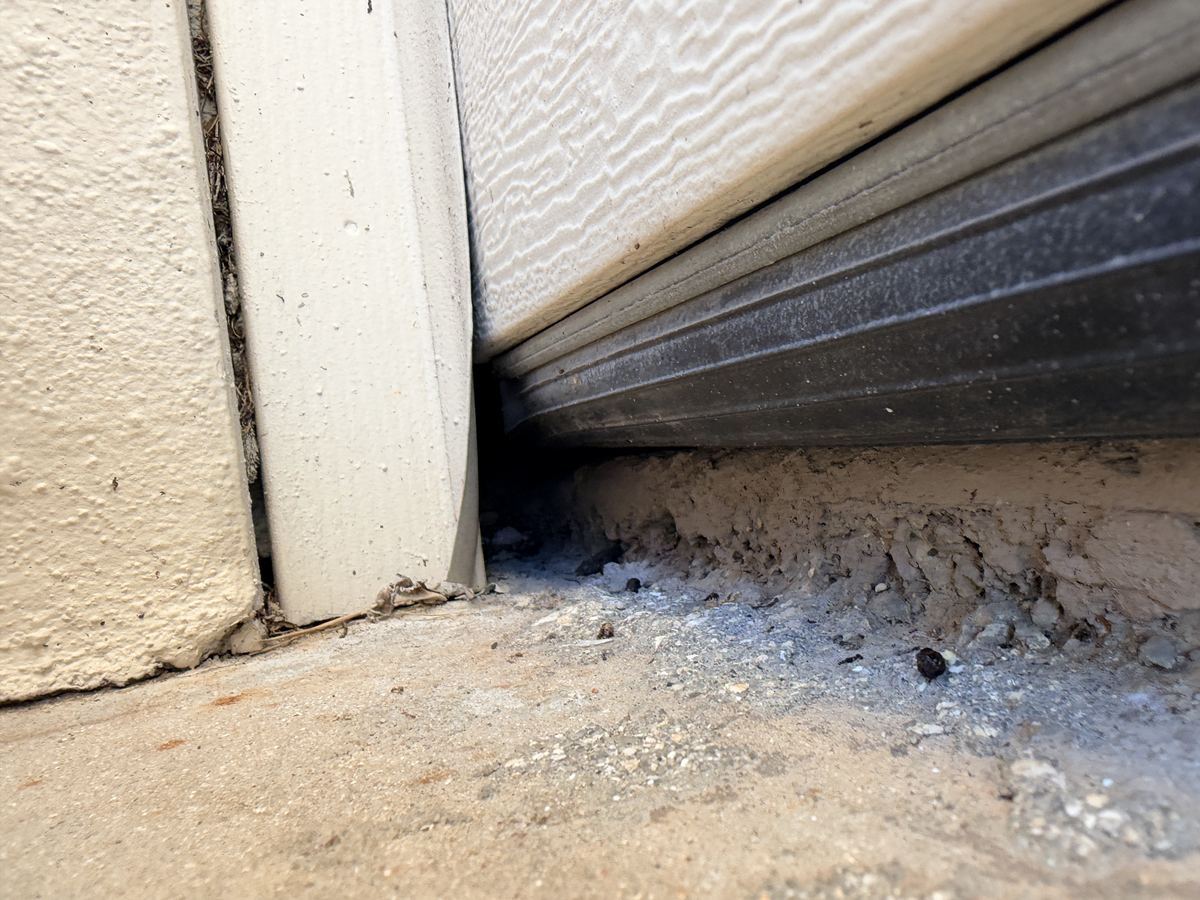 Before
Garage door corner: droppings collected right where the bottom seal stops short. That gap is the way in.
Related spots
Mice that use this gap often use these too. Check them on the same walk.
When in doubt, seal em out.