Utility penetrations
Every line that comes into the house, from power and gas to cable and phone, makes a hole. Those holes are rarely sealed well.
At your house
Not checked yet
Look at this spot with the free check. Your answers stay on this device.
Where to look
- Where power, cable and phone lines enter the wall.
- Around the electric meter, its conduit, and the gas line.
- Where pipes or conduit run up into the soffit or eaves.
- Old holes from lines that were removed but never patched.
Sign to look for Gnawed foam or a loose collar around a pipe, cable or vent, with droppings underneath.
The rule of thumb: if a gap is about the width of your finger, a mouse can use it. Also called the pencil or pinky test. A young mouse needs only a 1/4-inch gap, about the thickness of a standard pencil, to get its skull through. If the skull fits, the body follows.
Why mice use it, and the common mistake
Why mice use it
Utility holes are drilled larger than the line, and installers rarely come back to seal them. They're often low on the wall or tucked under the eaves, right where a mouse travels.
Common DIY mistake
Foaming around the line and calling it done. Foam alone gets chewed through, and it hides the gap instead of closing it.
The lasting fix
Back it with 1/4-inch hardware cloth (stainless or heavy galvanized) or exterior-grade metal, then seal it in with exterior-grade sealants or adhesives.
What NOT to seal
Some openings have to drain or breathe. Sealing them causes rot, mold or a safety problem.
- Never plug masonry weep holes solid. Cover them with breathable weep-hole guards, mesh or hardware cloth so water can still drain out.
- Never block combustion air vents. Gas furnaces and water heaters need that air to burn safely.
- Never block soffit or attic intake vents. The attic needs that airflow. Screen a damaged vent with hardware cloth instead of closing it.
- Never block dryer exhausts. They have to stay open to the outside.
The lasting fix, step by step
Find every penetration
Follow each line to where it enters the house, and look for old, unused holes too.
Check the size of the gap
If the gap around a line is about the width of your finger, it needs sealing.
Fit metal around the line
Fit 1/4-inch hardware cloth (stainless or heavy galvanized) around the line, without pinching or damaging it.
Seal it in
Seal over the metal with exterior-grade sealants or adhesives.
Patch old holes
Close unused holes with exterior-grade metal and sealants or adhesives, not just a plug.
Shared utility chases and meter banks are common property. Seal where lines enter your unit inside, often in closets and under sinks, and report outside gaps to your building manager.
Materials
- 1/4-inch hardware cloth, 19- or 23-gauge, stainless or heavy galvanized
- Exterior-grade metal patch
- Exterior-grade sealants or adhesives (not standard acrylic caulk)
- Gloves and flashlight
Specs that matter. Use 1/4-inch hardware cloth as the backing, then seal over it with exterior-grade sealants or adhesives. Half-inch mesh and cheap acrylic caulk from the hardware aisle won't stop young mice: they get their skulls through, and the body follows.
Safety notes
- Never open, unseal or work on the electric or gas meter itself. That belongs to the utility company.
- Don't pull on or damage service lines. If a line looks damaged, call the utility.
- Work around power lines only from the ground or a safely placed ladder well away from overhead service wires.
Before you seal the last gap
- Make sure nothing is still living inside. If mice are already in, set enclosed snap traps along the walls as you seal, never as a substitute for sealing.
- Clear clutter and cardboard away from walls and corners, so there are fewer places to nest.
On a real house
Before photos from homes we’ve inspected, with the gap marked in highlighter.
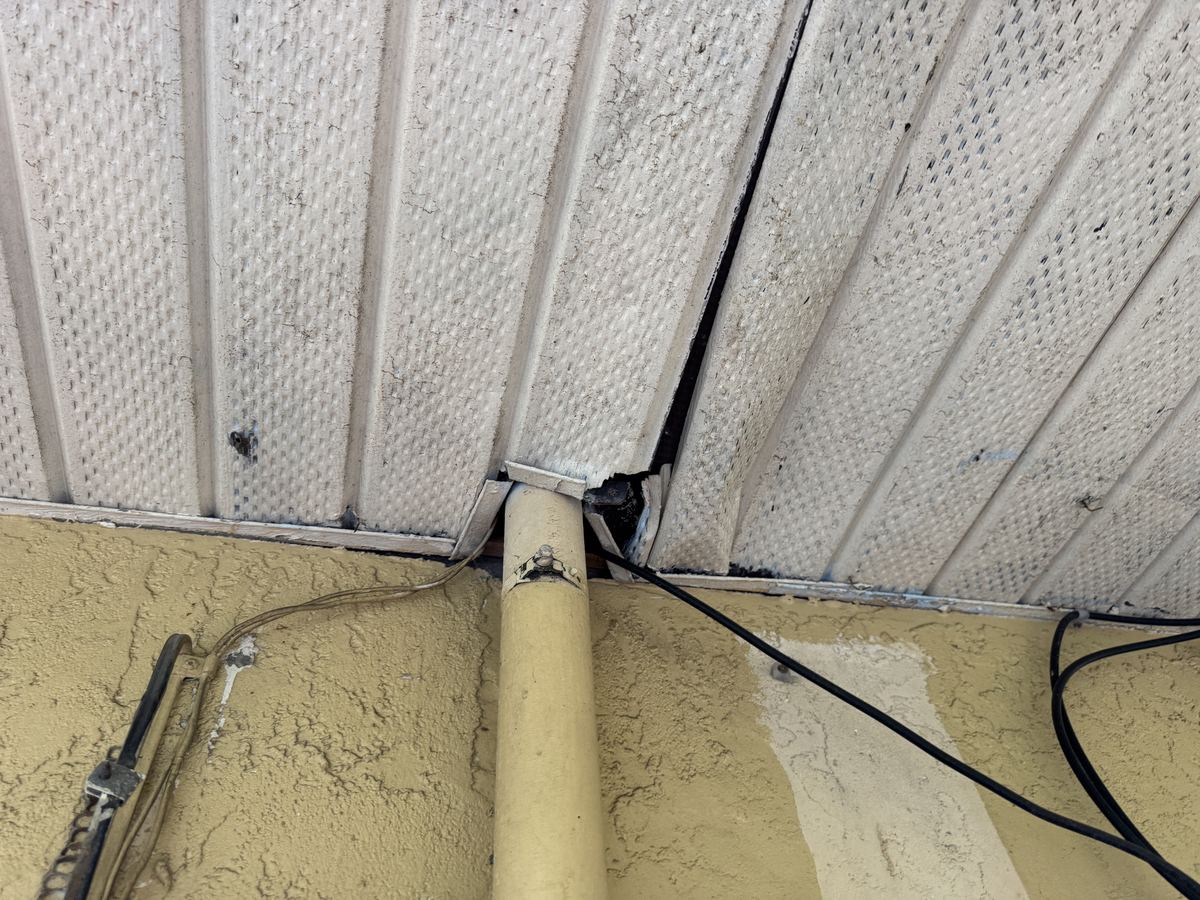 Before
Utility lines: where a pipe runs up into the soffit, the panel has broken away and left an open hole.
Related spots
Mice that use this gap often use these too. Check them on the same walk.
When in doubt, seal em out.